
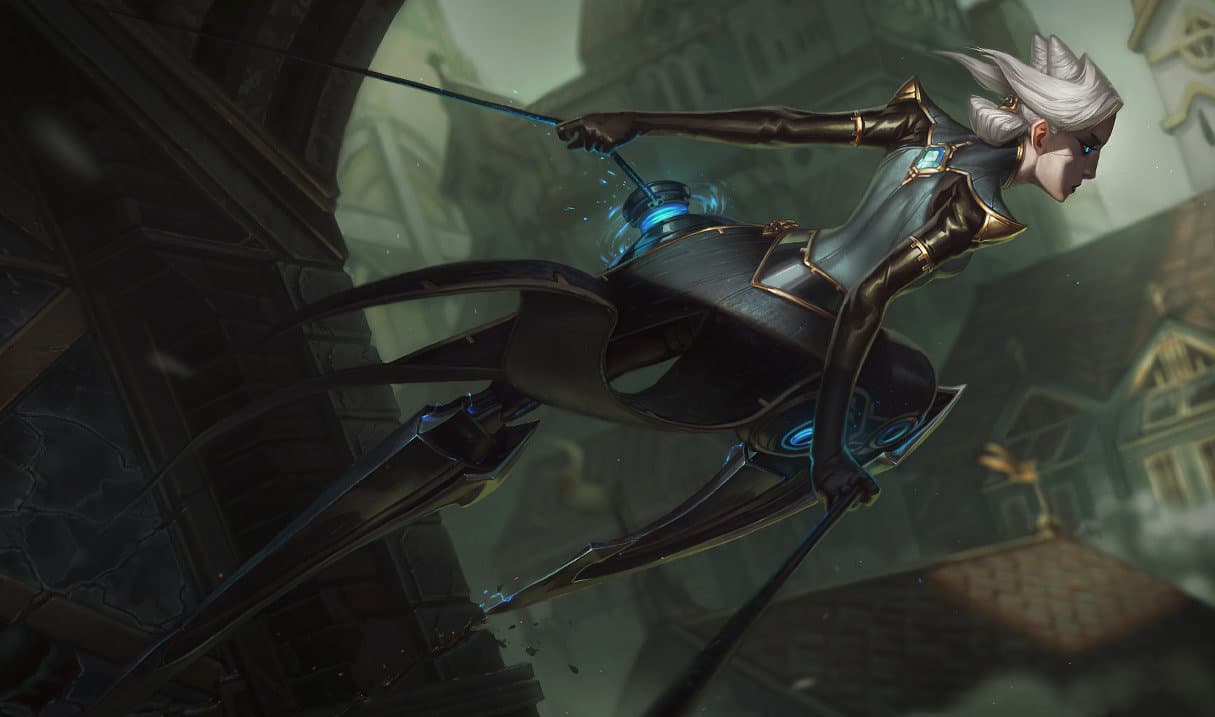

Guide · the Steel Shadow
Camille
A practical Camille playbook using Riot kit references and MacroDiff interpretation. Check the role, review date and patch context below.
MACRODIFF PLAYBOOK
How to think about Camille
Strengths, limits and power windows before you copy a build.
Strength profile
Scaling value
Scaling 3/3 indicates how much the kit classification values longer fights, levels or completed items. It is not a guaranteed late-game win rate.
Initiation options
Camille's bounded kit model rates engage at 2/3. Treat this as a composition signal, then confirm the actual opening with the ability text and enemy spacing.
Control chain
Crowd-control signal 2/3 makes timing with allied setup or follow-up especially valuable. Avoid overlapping the same control window without a reason.
Watch-outs
Limited protection after commitment
Peel is 0/3. Spending the key control or mobility tool aggressively can leave no answer for the return engage.
Do not borrow a frontline job
Frontline is 1/3. If allied durability is low, solve positioning and target access before volunteering to absorb the first contact.
Prefer follow-up to forced entry
Engage is 2/3. When the team lacks a clean opening, let another source create contact and use Precision Protocol on the confirmed window.
Power windows
Levels 1–2
Establish Precision Protocol
The max-order reference is Q → E → W, not necessarily the opening skill order. Check the actual ability learned, range and resource cost before trading.
Early skill points
Check the learned abilities
Do not assume all three basic abilities have been learned. Check the actual skill allocation and each tool's conditions before practicing an entry, follow-up or disengage.
R availability
The Hextech Ultimatum changes the decision tree
Riot's current description: Camille dashes to target champion, anchoring them to the area. She also deals bonus magic damage to the target with her basic attacks. Decide whether the cast creates access, protection, damage or an exit before using it.
Completed core
Re-check the team job
After the core build comes online, compare engage 2/3, peel 0/3, scaling 3/3 and frontline 1/3 again. Items can change priority without changing champion identity.
ROLE PLAN
Lane and tempo checklist
Trade around the wave
Use Precision Protocol as the first repeatable pattern, but keep enough space to disengage after the trade. Riot's current description: Camille's next attack deals bonus damage and grants bonus Move Speed. This spell can be recast for a short period of time, doing significantly increased bonus damage if Camille delays…
Track the long lane
Before pushing past river, account for enemy jungle access and your own escape tools. A favorable trade is not automatically a safe wave state.
Choose side lane or grouping
With frontline 1/3 and engage 2/3, decide whether Camille should absorb side pressure or arrive first to the next objective. When The Hextech Ultimatum is available, read its actual purpose before committing; not every R is an engage or escape.
5V5 PLAN
Team-fight responsibilities
Name the target before entering
Engage 2/3 supports opening, but only when allies can reach the same target. Ping or posture before spending the first key tool.
Preserve an exit
Peel 0/3 means the kit may not rescue a bad entry. Keep movement, range or terrain between Camille and the return threat.
Re-evaluate after the first cooldowns
The first exchange changes health, spacing and available tools. Pause long enough to choose between continuing, peeling back or changing target; do not replay the opening automatically.
COMMUNITY LAYER
Camille guides
Long-form decisions from MacroDiff editorial and community authors.